Showing posts with label book review. Show all posts

Thursday, 30 September 2010

Artistic Book Review no.2: Art and Fear


This was supposed to be published on August but Life ate up my time!

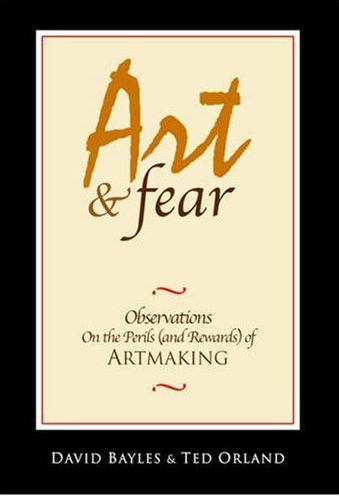
Art and Fear: Observations on the perils (and Rewards) of Artmaking.
By David Bayles & Ted Orland

ISBN: 978-0-9614547-3-9
Pages: 122 pages
Dimensions: 20.2cm x 13.9cm x 1.1cm
Price: Around 12 to 13 dollars

Personal Experience: You know being a booknerd such as myself, I have encountered far too many books about art and how to do this and that or books that will give you an in-sight about several aspects about this design and that art-piece. This is not one of them.

Many have praised this book and funnily enough, I never found one negative comment about it. Not even a zlitch, which made me curious for months until I got it lately in my hands. Not a fancy cover at all as if it is a reading book. Well to my surprise it IS a book to read it all from cover to cover. Literally. Let me just describe how much value this book has; this book does not sit on my shelves, this book sits on my bedside table.

Personal suggestion? If you can fetch it personally rather than waiting for the Library to fetch it for you will be much better because it is one of those books that will truly stay for life, no matter what artistic path you pick. An important piece of underground text, rarely heard of since it does not discuss some Mozart or Leonardo Da Vinci.

In a nutshell:
This book knows no age, no fixed occupation and no walks of life: it only knows the artist. As long as you're on the path of art-making this book is for you. The ONLY book you will really ever need to read from cover to cover; it's not long and even if you are inpatient in reading, a safe guarantee this will not be a waste of time. Other books are just trinkets no matter how big or informative they are. This book can be also classified as "philosophical" in a way, give or take. Don't get fooled though; this is no old Socrates philosophy, it's very much contemporary.

This piece of text targets areas such as: the outside world; how normal people see Art, how academic schools tackle Art, how a lecturer of Art can easily lose the time for art-making due to teaching art-making itself and so on. Even if you go beyond those feelings, what's the worth of making art? It also goes onto a personal level, such as the artists' fears, purposes, quality vs. quantity issue and so forth. As the book implies at the back of the cover in a good non-missable bold font: These are questions that matter.

Accompanied with good sarcastic humor, examples and thorough research from a hell lot of people the authors met and discussed the book's topics with, it will either be a huge boost of motivation if you are passionate in what you are doing or it will shoot your fleeting artistic muse down if you are taking your dedication for art too lightly. Do not expect this book to sugar-coat the world of art; on the contrary, this is a book packed with reality.

Bluntly put, this is the portal to the real world of Art & Design.

About the Authors:
David Bayles and Ted Orland are two artists that have written a number of books about art-making, but they are mostly known as being photographers.

Tuesday, 29 June 2010

Artistic Book Review no.1

Welcome to my very first artistic book review and as I am quite a book nerd, I thought I might just uncover some books that will help in the artistic factor. I will be reviewing one book each 3-4 weeks (or try to) that can be helpful in artistic development whether it is art, design or both. There are several reasons why this is being written, however main purposes of this reviews and the ones to come are the following:
  1. The college library might not have in offer yet, therefore people won't know about them. Hopefully with these reviews, they will become available.
  2. Topics offered under a different author and/or book. Books differ from one another of the same topics; if you can't find the information in what's available already, the reviews are here to give you yet another option consideration.
  3. Some of them may still be brand new and out of the printing press. Poor things need some proper lighting!
  4. Some people sometimes need eye-openers; so many titles to choose from that they really don't know where to go or what to choose. In a few words, trying to dodge or avoid confusion.
  5. Internet is overrated, big time. It can be as powerful as a book, however most of the times it is misinformative and/or misleading so do not rely on it too much for research.
I love my collection of books but I still rely on the Library for information. There are some books that I might not be able to afford or find, so I wholeheartedly support the Library. I personally try and build my own private collection to be honest; they will be there for life and it saves me precious time. You never know when you need them. (and I have a problem with overdue books)

Tip: Books are there to help you out and not to do your work, so do not just stick to just reading and do not plagarize. Gather information, process it and sketch it out. Knowledge is power but is only 1/10th of the work needed to be done; one learned technique, process or fact can drive your project from a mere pass to a flying distinction if you experiment enough.

So, what's my first book?


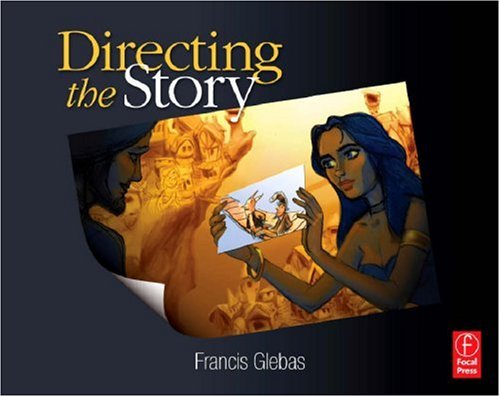
"Directing the Story: Professional Storytelling and Storyboarding Techniques for Live Action and Animation"
by Francis Glebas


Personal Experience:
When I saw the cover of this book I just knew it had to be on my shelf; a well designed cover of a book can tell you if it's platinum, gold, copper or charcoal quality. When I read this book it was even better, I literally felt like I have just found a diamond. This book is an eye-opener, a major motivator and a classroom in
346 pages. The structure of the book is beautiful and even if you're not really fond of reading, this will keep you hooked all the way. It is mainly targeted to illustrators that are interested in pursuing the career of animated film-making, however I found out that this book also applies for cartoonists that wish to plan out a long-series comicbooks story, just because the techniques offered help out that much.


In a nutshell: This book concerns about what it says on its cover; the storytelling part and whatever it involves with it. Just to let you know, this is not a book that will tell you how do the actual animation, only the pre-stages. Some might (including our dear lecturers) say that the editing part of the movie is the most crucial of all. Such a fact is true, however this book turns this theory upside down as it might not always be the case for animation or so the author says. Glebas begins with the common question of "why do we watch movies?". From that he builds up a step-by-step lesson of your life on how to script, beat box and storyboard your story...in preparation of making the actual animation of course.

That is not all; the book also go into extensive detail on several things such as how to build a good story, how to make interesting character designs, interaction within the characters and with the story itself and much, much more. Throughout the whole book there is also a continuous storyboard example flowing of a modified version of "1001 Arabian Nights", with the character Scheherezade playing as the main character. By following (and not just reading) this book makes you realize that the initial stages are just as important as the final assortments, re-organisation and touches, such as editing and special effects. Wonderfully written book, accompanied with a well-fitting page design, illustrations are at a generous abundance, vivid examples and personal suggestions, tips and hints from the author's personal life experiences in the career. Needless to say, this book is a must-have for animators and cartoonists alike, excellent starter for amateurs.

About the Author: Francis Glebas is a storyboard artist, teacher, director and writer. It can safely be said that Glebas has spent most of his life with the Disney Animation Studios. He has storyboarded animations that most probably built our childhood which are the following titles: Aladdin, Pocahontas, Hunchback of Notre Dame, Fantasia 2000 and Hercules. Other films that he has storyboarded are Dinosaur, Treasure Planet and Fox and the Hound 2.